



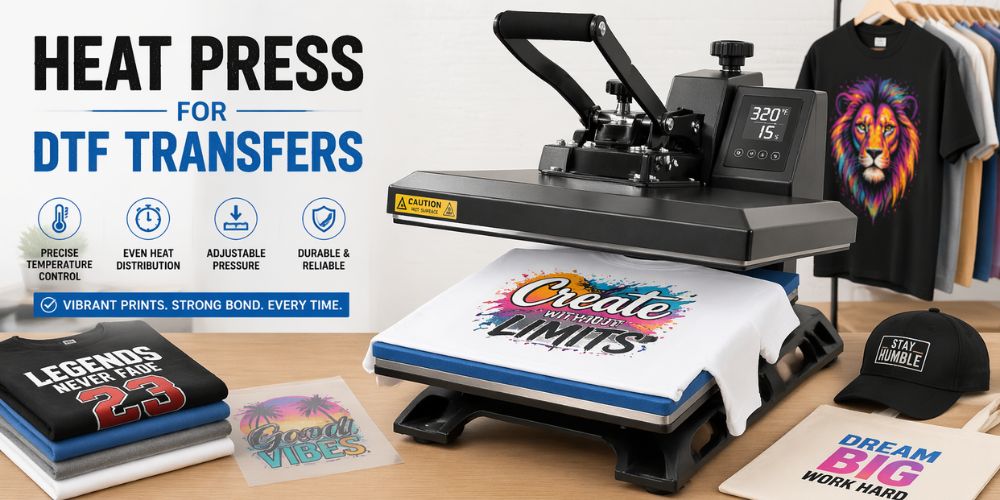
Most people setting up a heat press spend time getting the temperature right, picking the correct pressure and sourcing quality transfers. Then they grab whatever sheet is nearby and slap it on top. That one careless move is where a lot of otherwise good prints fall apart.
The cover sheet is not a throwaway accessory. It controls how heat reaches the adhesive powder, affects the final texture of the print and keeps the platen from collecting residue over time. Mad Monkey Transfers lays out which sheet actually works for DTF and when to use it.
What the Sheet Is Actually Doing
When a DTF transfer gets pressed, the heat melt powder sitting on the back of the film needs to reach a specific temperature to activate and bond into the fabric. That window is tight. Too little heat and the edges lift. Too much and the garment suffers for it.
A cover sheet placed between the platen and the transfer helps spread that heat more consistently across the design. Without one, hot spots form. Parts of the print bond fine while other sections barely make contact. The result is a transfer that looks good on the press table and starts peeling after three washes.
There is also a surface finish side to this. The material of the sheet directly influences whether the final print looks matte and clean or shiny and cheap.
The Cover Sheet Options
Parchment Paper
Parchment paper is what most people start with and honestly it is not a bad place to start. It has a light silicone coating that keeps it from sticking to the transfer and it handles the heat involved in DTF pressing without issues. Budget-friendly, easy to find and it leaves a decent matte finish on the transfer.
The real weakness is that it wears out. Run it through a few dozen presses and it starts to degrade. It also traps a bit of moisture, which is not a huge problem for most fabrics but worth keeping in mind for anything heat-sensitive.
Silicone Guard Sheets
This is where most serious decorators end up. Silicone guard sheets are reusable, handle high temperatures without flinching and spread pressure far more evenly than parchment. For DTF work, that even pressure matters more than people realize. The adhesive needs to melt uniformly across the whole design. Any variation and parts of the print simply do not bond.
On polyester and synthetic blends, silicone also cushions the heat contact, which cuts down significantly on those visible press marks that can ruin an otherwise clean garment. Anyone pressing more than a handful of shirts a week should be using one. It also helps to know how heat pressing works on polyester fabrics before deciding on a cover sheet, since the fabric itself changes the equation.
Teflon Sheets
Teflon is everywhere in the heat transfer world and people reach for it out of habit. The problem is that Teflon acts as a heat barrier. It can pull 10 to 20 degrees off the effective pressing temperature and for DTF that is enough to cause real adhesion problems. Transfers that look pressed come back off the shirt days later.
It is not unusable. Raising the temperature by at least 20°F compensates for the heat loss and Teflon does last a long time. But given the options, it is not the first tool anyone should be reaching for when pressing DTF transfers.
Fabric Changes the Calculation Too
Cotton is forgiving. Most cover sheet types work without any issues on a standard cotton tee. Polyester is a different story. The fibers are heat-sensitive and a flat silicone sheet softens the contact enough to avoid shiny press marks. Pressing at a slightly lower temperature on polyester blends also reduces the risk of damaging the fabric itself.
Nylon is the one where Teflon should not be used at all. Under heat and pressure, Teflon can actually bond to nylon and leave residue behind. A silicone sheet or parchment paper handles nylon without that risk.
Getting these details right connects to the broader process. Understanding the correct paper settings for DTF printing is part of the same picture, since application quality depends on multiple settings working together.
Conclusion
The cover sheet is about a two-second decision at the press. But it protects the garment, keeps the platen clean and is the difference between a transfer that lasts and one that does not.
For transfers that are already built to apply cleanly and hold up long-term, the Custom DTF Transfers at Mad Monkey Transfers are worth a look.